#include <init.hpp>
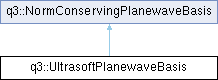
 Inheritance diagram for q3::UltrasoftPlanewaveBasis:
Public Member Functions | |
| UltrasoftPlanewaveBasis ()=default | |
| ~UltrasoftPlanewaveBasis () override=default | |
| void | add_augmentation_charges (const Crystal &crystal_structure, const Matrix< Real > &projector_overlap_coefficients, std::vector< Complex > &charge_density_g, const std::vector< std::vector< Complex > > *cached_structure_factors=nullptr) const |
| Real | augmentation_overlap_integral (int species_type, int projector_a, int projector_b) const |
| const AugmentationQTable & | augmentation_q_table () const |
| Complex | compute_q_g_single (int species_type_index, int projector_index_i, int projector_index_j, const Vector3D &g_cartesian, Real two_pi_over_lattice_parameter) const |
| const GauntCoefficientTable & | gaunt_table () const |
| bool | has_q_functions_g (int species_type_index) const |
| void | init (const Crystal &crystal_structure, const PlanewaveBasis &planewave_basis, const PseudopotentialSet &pseudopotential_set) override |
| Real | interpolate_qfunc (int species_type_index, int projector_pair_index, Real q_value) const |
| bool | is_ultrasoft () const override |
| const Complex * | q_function_g_data (int species_type_index, int channel_pair_index, int number_of_g_vectors) const |
| Complex | q_function_g_value (int species_type_index, int channel_pair_index, int g_index, int number_of_g_vectors) const |
| const SphericalHarmonicsTable & | spherical_harmonics_table () const |
| Public Member Functions inherited from q3::NormConservingPlanewaveBasis | |
| NormConservingPlanewaveBasis ()=default | |
| virtual | ~NormConservingPlanewaveBasis ()=default |
| const std::vector< Real > & | atomic_charge_density_g (int species_type) const |
| Real | bare_d_matrix_element (int species_type, int projector_a, int projector_b) const |
| int | beta_angular_momentum (int species_type, int projector_index) const |
| const BetaFunctionTable & | beta_function_table () const |
| const std::vector< Complex > & | core_charge_density_reciprocal () const |
| const CoreChargeDensityTable & | core_charge_density_table () const |
| bool | has_nonlinear_core_correction () const |
| Real | interpolate_beta (int species_type_index, int beta_index, Real q_value) const |
| Real | interpolate_core_charge_density (int element_type, Real q_value) const |
| Real | interpolate_core_charge_density_derivative (int element_type, Real q_value) const |
| Real | interpolate_dbeta (int species_type_index, int beta_index, Real q_value) const |
| Real | interpolate_local_potential (int element_type, Real q_value) const |
| Real | interpolate_local_potential_derivative (int element_type, Real q_value) const |
| Real | interpolate_rho_core (int element_type, Real q_value) const |
| const std::vector< Real > & | local_potential_g (int species_type_index) const |
| const LocalPotentialTable & | local_potential_table () const |
| int | number_of_projector_channels (int species_type) const |
| int | number_of_projectors (int species_type) const |
| const PlanewaveBasis & | planewave_basis () const |
| int | projector_angular_momentum (int species_type, int projector_index) const |
| int | projector_combined_lm_index (int species_type, int projector_index) const |
| int | projector_magnetic_quantum_number (int species_type, int projector_index) const |
| const ProjectorMappingTable & | projector_mapping_table () const |
| int | projector_to_beta_index (int species_type, int projector_index) const |
| const PseudopotentialSet & | pseudopotential_set () const |
| const std::vector< Complex > & | total_local_potential_g () const |
| int | total_number_of_projectors () const |
Protected Member Functions | |
| void | init_ultrasoft (const Crystal &crystal_structure, const PlanewaveBasis &planewave_basis) |
| void | precompute_q_functions_g (const PlanewaveBasis &planewave_basis) |
| Protected Member Functions inherited from q3::NormConservingPlanewaveBasis | |
| void | compute_mesh_truncation_sizes (int number_of_species_types) |
Static Protected Member Functions | |
| static int | projector_degree_for_gaunt_table (const PseudopotentialSet &pseudopotential_set, int maximum_angular_momentum_q) |
Additional Inherited Members | |
| Protected Attributes inherited from q3::NormConservingPlanewaveBasis | |
| std::vector< std::vector< Real > > | atomic_charge_density_g_ |
| std::unique_ptr< BetaFunctionTable > | beta_function_table_ |
| Real | cell_volume_ {1.0} |
| CoreChargeData | core_charge_data_ |
| CoreChargeDensityTable | core_charge_density_table_ |
| std::vector< std::vector< Real > > | local_potential_g_per_species_ |
| LocalPotentialTable | local_potential_table_ |
| std::vector< int > | mesh_sizes_ |
| const PlanewaveBasis * | planewave_basis_ptr_ = nullptr |
| ProjectorMappingTable | projector_mapping_table_ |
| PseudopotentialSet | pseudopotential_set_ |
| std::vector< Complex > | total_local_potential_g_ |
Detailed Description
Constructor & Destructor Documentation
◆ UltrasoftPlanewaveBasis()
|
default |
◆ ~UltrasoftPlanewaveBasis()
|
overridedefault |
Member Function Documentation
◆ add_augmentation_charges()
|
inline |
Add ultrasoft augmentation charges to the charge density in G-space.
Uses the pre-computed Q_ij(G) table for O(atoms × pairs × G) cost, eliminating the per-G interpolation that dominated the previous implementation.
- Parameters
-
crystal_structure Crystal geometry projector_overlap_coefficients ⟨ψ|β⟩⟨β|ψ⟩ summed over bands charge_density_g Charge density in G-space (modified in place)
Skip species that have no Q(G) table, exactly as the augmentation force kernel in forces/.../ultrasoft/internal/augmentation.hpp already does — the two assemble the same A_I(G) and must agree on which atoms contribute to it.
In a mixed cell precompute_q_functions_g leaves the entry for a norm-conserving species empty, but ρ_ij is accumulated over every atom, so its ⟨ψ|β_i⟩⟨β_j|ψ⟩ are nonzero and this loop reached q_function_g_data for it anyway. That takes the address of an element of an empty vector and then reads number_of_g_vectors complex values through it — out of bounds on every SCF iteration, silently corrupting the density rather than failing outright. A norm-conserving species has no augmentation charge to add, so contributing nothing is also the right answer.
Accumulate ρ_ij-weighted Q_ij(G) over all channel pairs. Exploit Q_ij(G) = Q_ji(G) symmetry: loop only over upper triangle. For i < j: use (ρ_ij + ρ_ji) * Q_ij(G) in a single pass. For i == j: use ρ_ii * Q_ii(G) directly.
Definition at line 178 of file init.hpp.
References q3::compute_phase_factor(), q3::Crystal::convert_from_crystal_to_cartesian(), q3::PlanewaveBasis::g_vectors(), has_q_functions_g(), q3::Crystal::number_of_atoms(), q3::ProjectorMappingTable::number_of_channels(), q3::PlanewaveBasis::number_of_g_vectors(), q3::NormConservingPlanewaveBasis::number_of_projector_channels(), q3::NormConservingPlanewaveBasis::planewave_basis_ptr_, q3::NormConservingPlanewaveBasis::projector_mapping_table_, q_function_g_data(), q3::Crystal::species_type_index(), and q3::constants::two_pi.
◆ augmentation_overlap_integral()
|
inline |
Augmentation overlap integral q_{ij} = ∫ Q_ij(r) dr, or zero when the species carries no augmentation charges.
The gate belongs here, not in each caller. This class is instantiated whenever any species needs augmentation, so a mixed cell — one ultrasoft or PAW species alongside one norm-conserving species — brings its norm-conserving species through every method on it. as_ultrasoft is a dynamic_cast whose null check is an assert, so asking a norm-conserving species for its q_ij aborts a Debug build and dereferences null in the Release builds users actually run.
q_ij = 0 is the physically correct answer, not merely a safe one: a norm-conserving dataset has no augmentation charges, so it contributes nothing to S = 1 + Σ q_ij |β_i⟩⟨β_j|. Its projectors still participate in the nonlocal potential; only the augmentation term vanishes.
Callers used to carry this test themselves and mostly did not — the whole-system has_ultrasoft() flag reads as if it settled the question per species, and it does not. hubbard_augmentation_overlap and the force kernel in forces/.../nonlocal.hpp grew their own copies for this exact reason; a mixed US+NC cell still aborted in the wavefunction initializer's overlap, which had none.
- Parameters
-
species_type Species index projector_a Beta projector index i (radial) projector_b Beta projector index j (radial)
Definition at line 123 of file init.hpp.
References q3::PseudopotentialSet::as_ultrasoft(), q3::UltrasoftPseudopotential::augmentation_overlap_integrals, and q3::NormConservingPlanewaveBasis::pseudopotential_set_.
Referenced by q3::hubbard_augmentation_overlap().
◆ augmentation_q_table()
|
inline |
◆ compute_q_g_single()
|
inline |
Compute the augmentation Q-function Q_ij(G) for a single G-vector.
- Parameters
-
species_type_index Species index projector_index_i Projector channel index i projector_index_j Projector channel index j g_cartesian G-vector in Cartesian reciprocal units (2π/a) two_pi_over_lattice_parameter Conversion factor 2π/alat
- Returns
- Complex Q_ij(G) value
Same per-species gate as augmentation_overlap_integral: Q_ij(G) is identically zero for a species with no augmentation charges, and reaching for its (nonexistent) table is the Release null dereference.
Definition at line 288 of file init.hpp.
References q3::ProjectorMappingTable::angular_momentum(), q3::PseudopotentialSet::as_ultrasoft(), q3::UltrasoftPseudopotential::augmentation_overlap_integrals, q3::GauntCoefficientTable::coefficients, q3::ProjectorMappingTable::combined_lm_index(), q3::compute_real_spherical_harmonic(), q3::AugmentationQTable::interpolate_augmentation_function(), q3::AugmentationQTable::maximum_angular_momentum_q(), q3::GauntCoefficientTable::nonzero_product_indices, q3::Vector3D::norm(), q3::GauntCoefficientTable::number_of_nonzero_product_indices, q3::NormConservingPlanewaveBasis::number_of_projectors(), q3::NormConservingPlanewaveBasis::projector_mapping_table_, q3::NormConservingPlanewaveBasis::pseudopotential_set_, q3::ProjectorMappingTable::to_beta_index(), and q3::math::tolerances::zero_vector_magnitude_threshold.
Referenced by q3::PlanewaveBlochOverlapCalculator::add_augmentation_contribution().
◆ gaunt_table()
|
inline |
◆ has_q_functions_g()
|
inline |
Check whether Q(G) table is available for a species.
Definition at line 163 of file init.hpp.
Referenced by add_augmentation_charges().
◆ init()
|
inlineoverridevirtual |
Initialize all pseudopotential data from crystal, basis, and PP files. Must be called after PlanewaveBasis::generate().
Step 2: Tabulate beta functions on a uniform q-grid, with the table implementation chosen by what the datasets carry (see the factory).
Reimplemented from q3::NormConservingPlanewaveBasis.
Definition at line 46 of file init.hpp.
References q3::NormConservingPlanewaveBasis::init(), init_ultrasoft(), q3::NormConservingPlanewaveBasis::planewave_basis(), and q3::NormConservingPlanewaveBasis::pseudopotential_set().
Referenced by q3::UltrasoftPlanewaveKohnShamQuantumSystem::init().
◆ init_ultrasoft()
|
inlineprotected |
Definition at line 391 of file init.hpp.
References q3::NormConservingPlanewaveBasis::beta_function_table_, q3::Crystal::cell_volume(), q3::NormConservingPlanewaveBasis::cell_volume_, q3::generate_gaunt_coefficients(), q3::log::info(), q3::SphericalHarmonicsTable::init(), q3::AugmentationQTable::init(), q3::AugmentationQTable::maximum_angular_momentum_q(), q3::NormConservingPlanewaveBasis::mesh_sizes_, q3::NormConservingPlanewaveBasis::planewave_basis(), precompute_q_functions_g(), projector_degree_for_gaunt_table(), and q3::NormConservingPlanewaveBasis::pseudopotential_set_.
Referenced by init().
◆ interpolate_qfunc()
|
inline |
Interpolate augmentation function Q_{ij}(|q|) from the radial table.
- Parameters
-
species_type_index Species index projector_pair_index Linearized (i,j) pair index for the Q function q_value Wavevector magnitude in atomic units
Definition at line 89 of file init.hpp.
References q3::AugmentationQTable::interpolate_qfunc().
◆ is_ultrasoft()
|
inlineoverridevirtual |
Whether this basis uses ultrasoft pseudopotentials. Base class returns false; UltrasoftPlanewaveBasis returns true.
Reimplemented from q3::NormConservingPlanewaveBasis.
◆ precompute_q_functions_g()
|
inlineprotected |
Pre-compute Q_ij(G) for all G-vectors and all channel pairs per species.
For each species s with N_ch channels and each pair (i,j): Q_ij(G) = Σ_{lm} gaunt(lm, lm_i, lm_j) * Q_ij^l(s, |G|)
- Ylm(Ĝ) * (-i)^l
where Q_ij^l(s, |G|) is the radial Fourier transform of species s's augmentation function Q_ij in channel l (interpolate_augmentation_function).
Stored as q_functions_g_[species][pair_linear_index][g_index] where pair_linear_index = channel_i * n_channels + channel_j.
Memory: n_species × n_channels² × n_g_vectors × sizeof(Complex)
Capability, not type — a PAW species has Q_ij^L too (synthesized for datasets that ship only the augmentation charges) and needs the same Q(G) table.
Definition at line 477 of file init.hpp.
References q3::ProjectorMappingTable::angular_momentum(), q3::GauntCoefficientTable::coefficients, q3::ProjectorMappingTable::combined_lm_index(), q3::PlanewaveBasis::g_vector_magnitudes(), q3::log::info(), q3::AugmentationQTable::interpolate_augmentation_function(), q3::AugmentationQTable::maximum_angular_momentum_q(), q3::GauntCoefficientTable::nonzero_product_indices, q3::ProjectorMappingTable::number_of_channels(), q3::PlanewaveBasis::number_of_g_vectors(), q3::GauntCoefficientTable::number_of_nonzero_product_indices, q3::NormConservingPlanewaveBasis::number_of_projector_channels(), q3::NormConservingPlanewaveBasis::planewave_basis(), q3::NormConservingPlanewaveBasis::projector_mapping_table_, q3::NormConservingPlanewaveBasis::pseudopotential_set_, q3::PseudopotentialSet::size(), q3::ProjectorMappingTable::to_beta_index(), and q3::SphericalHarmonicsTable::value().
Referenced by init_ultrasoft().
◆ projector_degree_for_gaunt_table()
|
inlinestaticprotected |
The projector degree the Gaunt table is to be built for, checked against the product degree its consumers will index.
generate_gaunt_coefficients expands products of projector harmonics, so its argument is the projector degree and it evaluates harmonics up to twice that. What used to be passed instead was maximum_angular_momentum_q(), which is the maximum L of the Q expansion and is already twice the projector degree – so the table was sized for a product degree of 8 on any d-channel dataset, its collocation asked for harmonics at degrees 5 through 8, and compute_real_spherical_harmonic answered every one of them with 0.0.
Nothing observed it: the damaged entries are the ones no consumer indexes. Consumers reach product degree lmaxq and no further, and every entry at or below that sum was correct. The table was simply about nine times larger than anything reads, with the excess wrong.
Passing the projector degree makes the collocation exact over exactly the range consumers use, and – because it no longer doubles an already doubled degree – lets the harmonic refusal above degree 4 be added without rejecting every ultrasoft and PAW run.
The relation lmaxq <= 2 * projector_degree is what makes the smaller table still cover every index a consumer forms. It holds for every dataset Q3 reads, because lmaxq is derived from the projector channels; a dataset that declared otherwise would index past the end of the table, so it is checked rather than assumed.
Definition at line 442 of file init.hpp.
References q3::NormConservingPlanewaveBasis::pseudopotential_set(), and q3::PseudopotentialSet::size().
Referenced by init_ultrasoft().
◆ q_function_g_data()
|
inline |
Access the raw Q(G) data pointer for a given species and channel pair.
Returns a pointer to number_of_g_vectors contiguous Complex values. Used for BLAS-accelerated dot products in newd and addusdens.
Definition at line 154 of file init.hpp.
Referenced by add_augmentation_charges(), and q3::UltrasoftPlanewaveEffectivePotential::compute().
◆ q_function_g_value()
|
inline |
Access a pre-computed Q_ij(G) value.
- Parameters
-
species_type_index Species index channel_pair_index Linearized channel pair: channel_i * n_channels + channel_j g_index G-vector index number_of_g_vectors Total number of G-vectors (stride for flat indexing)
- Returns
- The pre-computed Q_ij(G) complex value
◆ spherical_harmonics_table()
|
inline |
The documentation for this class was generated from the following file:
- src/layer_3_representation/basis/planewave/pseudopotential/ultrasoft/init.hpp