#include <init.hpp>
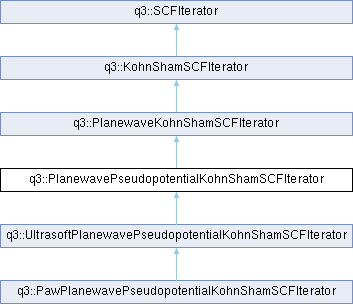
 Inheritance diagram for q3::PlanewavePseudopotentialKohnShamSCFIterator:
Public Member Functions | |
| PlanewavePseudopotentialKohnShamSCFIterator (KohnShamSCFIteratorConfig config) | |
| ~PlanewavePseudopotentialKohnShamSCFIterator () override=default | |
| const NormConservingPlanewaveKohnShamEnergies & | energies () const override |
| NormConservingPlanewaveKohnShamEnergies & | energies_mutable () override |
| const std::vector< std::vector< Real > > & | hubbard_occupation_traces () const |
| virtual void | load_one_center_occupations (const std::vector< Matrix< Real > > &occupations_by_spin) |
| const NormConservingPlanewaveKohnShamQuantumSystem & | norm_conserving_quantum_system () const |
| void | offer_starting_wavefunctions (std::string save_directory) |
| virtual std::vector< Matrix< Real > > | one_center_occupations () const |
| virtual const Matrix< Real > & | projector_overlap_coefficients () const |
| const PseudopotentialSet & | pseudopotential_set () const |
| void | refresh_quantum_system_snapshot () |
| void | release_scf_workspace () override |
| virtual bool | requires_one_center_occupations () const |
| NormConservingPlanewaveKohnShamSCFState | result () const override |
| void | set_diagonalizer_maximum_iterations_for_nscf (int maximum_iterations) |
| void | set_diagonalizer_tolerance_for_nscf (Real tolerance) |
| void | set_owned_pseudopotential_set (PseudopotentialSet pseudopotential_set) |
| Transfer ownership of a PseudopotentialSet into this iterator. | |
| std::vector< Complex > | valence_exchange_correlation_potential_g_of (const std::vector< std::vector< Real > > &charge_density_real) |
| void | write_checkpoints (const std::string &output_directory, const std::string &prefix) const override |
| Public Member Functions inherited from q3::PlanewaveKohnShamSCFIterator | |
| PlanewaveKohnShamSCFIterator (KohnShamSCFIteratorConfig config) | |
| ~PlanewaveKohnShamSCFIterator () override=default | |
| Real | eigenvalue (int kpoint_index, int band_index) const |
| Matrix< Real > | eigenvalues () const |
| const execution::PlanewaveExecutionPolicy & | execution_policy () const |
| const std::vector< std::vector< int > > & | g_vector_indices () const |
| const std::vector< int > & | g_vector_indices (int kpoint_index) const |
| Matrix< Real > | global_eigenvalues () const |
| const std::vector< std::vector< Real > > & | kinetic_energy_squared () const |
| const KPointsGrid & | kpoint_grid () const |
| void | load_quantum_system (const PlanewaveKohnShamQuantumSystem &system) |
| bool | loaded_charge_density_fits_grid () const |
| const std::optional< Magnetization > & | magnetization () const |
| int | number_of_bands () const override |
| Real | number_of_electrons () const override |
| int | number_of_kpoint_states () const override |
| int | number_of_occupied_bands_per_spin () const |
| const std::vector< int > & | number_of_plane_waves () const |
| int | number_of_plane_waves (int kpoint_index) const |
| Real | occupation (int kpoint_index, int band_index) const |
| const PlanewaveBasis & | planewave_basis () const |
| void | preload_charge_density () |
| void | preload_single_particle_states () |
| const PlanewaveKohnShamQuantumSystem & | quantum_system () const |
| void | scale_loaded_charge_density_to_electron_count () |
| Rescale the loaded density so it integrates to this system's electron count. | |
| void | set_diagonalizer (std::unique_ptr< PlanewaveDiagonalizer > diagonalizer) |
| void | set_owned_execution_policy (std::unique_ptr< execution::PlanewaveExecutionPolicy > policy) |
| void | set_owned_kpoint_grid (KPointsGrid kpoint_grid) |
| Transfer ownership of a KPointsGrid into this iterator. | |
| Real | spin_degeneracy () const |
| Complex | wavefunction (int kpoint_index, int band_index, int g_vector_index) const |
| Public Member Functions inherited from q3::KohnShamSCFIterator | |
| KohnShamSCFIterator (KohnShamSCFIteratorConfig config) | |
| ~KohnShamSCFIterator () override=default | |
| const std::vector< Real > & | charge_density_for_spin (int spin_index) const |
| const std::vector< Complex > & | charge_density_g () const |
| const std::vector< Real > & | charge_density_real () const |
| Crystal & | crystal_structure () const |
| const XCFunctional & | exchange_correlation () const |
| const std::vector< Complex > & | exchange_correlation_potential_g () const |
| void | load_charge_density (std::vector< std::vector< Real > > charge_density) |
| void | load_effective_potential (std::vector< std::vector< Real > > effective_potential) |
| void | offer_starting_charge_density (std::vector< std::vector< Real > > charge_density) |
| const std::vector< Real > & | potential_for_spin (int spin_index) const |
| const std::vector< Real > & | real_space_potential () const |
| const std::vector< ScfIterationRecord > & | scf_history () const |
| Real | total_energy () const override |
| const std::vector< Complex > & | total_potential_g () const |
| Public Member Functions inherited from q3::SCFIterator | |
| SCFIterator (SCFIteratorConfig config) | |
| virtual | ~SCFIterator ()=default |
| bool | is_converged () const |
| int | iteration () const |
| int | number_of_spin_components () const |
| void | run () |
| void | set_convergence_threshold (Real threshold) |
| Set the SCF convergence threshold (in Ry). | |
| void | set_maximum_iterations (int maximum_iterations) |
| Set the maximum number of SCF iterations. | |
| void | set_owned_crystal (Crystal crystal) |
| Transfer ownership of a Crystal into this iterator. | |
| const std::vector< Real > & | total_energy_history_in_ry () const |
Protected Member Functions | |
| void | accumulate_hubbard_occupation_and_potential () |
| const std::vector< SymmetryOperation > & | cached_symmetry_operations () const |
| Real | compute_double_counting_correction () const override |
| void | compute_effective_potential_from_density () override |
| void | construct_density_from_states () override |
| const std::vector< Complex > & | core_charge_density_g () const override |
| void | create_norm_conserving_quantum_system_snapshot () |
| NormConservingPlanewaveEffectivePotentialCalculator & | effective_potential_calculator () |
| std::vector< Real > | effective_species_magnetizations () const |
| void | fix_edge_kpoints_with_backward_propagation (int number_of_kpoints, int number_of_kpoint_states) |
| Real | hubbard_potential_energy () const |
| void | initialize_charge_density () override |
| void | initialize_charge_density_from_atomic_superposition () |
| void | initialize_representation () override |
| void | initialize_single_particle_states () override |
| bool | is_at_band_path_segment_boundary (int kpoint_index) const |
| bool | is_iteration_converged () const override |
| const std::vector< Complex > & | local_ionic_potential_g () const override |
| void | log_pseudopotential_summary (int number_of_atomic_wavefunctions) const |
| void | propagate_wavefunctions_backward (int source_kpoint_state_index, int target_kpoint_state_index) |
| void | propagate_wavefunctions_to_next_kpoint (int current_kpoint_state_index, int total_kpoint_states) |
| std::vector< std::vector< Complex > > | read_saved_bands (int kpoint_index) const |
| void | report_memory_estimate (int number_of_atomic_wavefunctions) const |
| void | report_unconverged_solve (int kpoint_index_state) const |
| void | setup_hubbard () |
| void | solve_single_particle_states () override |
| bool | take_saved_starting_wavefunctions (int kpoint_index, std::vector< std::vector< Complex > > &starting_wavefunctions) const |
| Protected Member Functions inherited from q3::PlanewaveKohnShamSCFIterator | |
| void | allocate_electronic_states () |
| void | build_kpoint_plane_wave_data () |
| Real | compute_delta_escf_correction () const override |
| Real | compute_density_residual (const std::vector< std::vector< Real > > &input_density_for_mixing) const override |
| void | compute_energy_components () override |
| Real | compute_local_residual_between (const std::vector< std::vector< Real > > &density_in, const std::vector< std::vector< Real > > &density_out) const |
| Real | compute_number_of_electrons () const |
| Real | compute_residual_between (const std::vector< std::vector< Real > > &density_in, const std::vector< std::vector< Real > > &density_out) const |
| Real | effective_charge_density_energy_cutoff () const |
| Real | hartree_metric_prefactor () const |
| void | initiate_mixer () override |
| std::vector< std::vector< Real > > | input_density_for_mixing () const override |
| void | log_representation_summary () const |
| Real | magnetization_metric_weight () const |
| void | mix_density (const std::vector< std::vector< Real > > &input_density_for_mixing) override |
| virtual void | on_charge_density_initialized () |
| const PlanewaveKohnShamEnergies & | planewave_energies () const |
| PlanewaveKohnShamEnergies & | planewave_energies_mutable () |
| void | report_convergence_details () override |
| void | report_first_iteration_details () override |
| int | resolve_number_of_bands () const |
| void | restore_density_at_convergence () override |
| void | set_diagonalization_tolerance (int iteration) override |
| void | set_diagonalizer_tolerance (Real tolerance) override |
| void | snapshot_output_density () override |
| void | symmetrize_density () override |
| void | update_effective_potential () override |
| void | update_occupations () override |
| void | warn_if_total_charge_deviates () const |
| Protected Member Functions inherited from q3::KohnShamSCFIterator | |
| const KohnShamSCFIteratorConfig & | config () const |
| Real | diagonalization_threshold () const |
| void | finalize () override |
| void | initialize () override |
| Base implementation prints the SCF banner. Children call SCFIterator::initialize() last. | |
| void | log_iteration_energy (Real delta_energy) |
| Single source of truth for the per-iteration energy/convergence log line. | |
| void | perform_iteration () override |
| virtual void | prepare_hamiltonian () |
| void | report_convergence () override |
| void | report_iteration () override |
| void | report_non_convergence () override |
| virtual void | synchronize_smooth_density_from_mixed () |
| Protected Member Functions inherited from q3::SCFIterator | |
| virtual void | iterate () |
| Main iteration loop. | |
| virtual void | report () |
| Report convergence or non-convergence after iterate() finishes. | |
Additional Inherited Members | |
| Public Attributes inherited from q3::KohnShamSCFIterator | |
| KohnShamSCFIteratorConfig | config_ |
| std::string | exchange_correlation_functional_ |
| int | methfessel_paxton_order_ |
| Real | mixing_beta_ |
| int | mixing_history_size_ |
| std::string | mixing_mode_ |
| std::string | mixing_preconditioning_ |
| Real | mixing_q0_ |
| std::string | smearing_ |
| Real | smearing_width_ |
|
inlineexplicit |
|
overridedefault |
|
inlineprotected |
Recompute the DFT+U occupation matrix from this iteration's converged wavefunctions, then the Dudarev energy and D-matrix for each spin channel. Called once per SCF iteration (after all k-points/spins are solved), mirroring UltrasoftPlanewavePseudopotentialKohnShamSCFIterator::accumulate_projector_overlaps()'s k-point-state loop and pool-reduction pattern. No-op if hubbard_manifolds_ is empty.
All <phi_j|psi_b> for this k-point in one ZGEMM – see compute_hubbard_projector_overlaps()'s docstring for why this is batched over every Hubbard orbital rather than looped per manifold. Only occupied bands are contracted, as the scalar loop this replaced also skipped the rest.
Gamma-only sums over half the G sphere, so <phi_m|psi> comes out at half its full-sphere value plus an Im-Im cross term. Completing it here rather than inside the occupation kernel keeps n_mm' = conj(O_m) O_m' exactly as written, and makes n real symmetric – which in turn makes the Dudarev D matrix real, so the Hamiltonian term it feeds preserves the half sphere's reality condition.
Scatter this manifold's row block; unoccupied bands stay zero, exactly as the scalar loop's continue left them.
Under MPI band-parallelism (G-vector distribution within a k-point pool), each rank's g_index loop above only covers its LOCAL plane-wave subset, so overlaps here is only a partial <phi_m|psi> sum – reduce across the band-parallel group before use, mirroring the applicator's identical <phi_m|psi> reduction for the H|psi> Hubbard term (hamiltonian_applicator/serial.hpp's reduce_within_group(hubbard_overlaps, ...)). A no-op when band_size == 1 (serial ExecutionPolicy's reduce_within_group()).
Each pool computed the occupation matrix only for its subset of k-points. Flatten (Complex has no reduce_vector overload) -> reduce across pools -> unflatten.
Restore the symmetry the IBZ sum does not carry: time reversal, then the spatial operations.
n has angular indices, so a weighted irreducible-wedge sum does not reproduce the full-zone result the way an invariant scalar does — the trace comes out right and the structure does not. Averaging over the group is what QE does too; without it silicon's 3p manifold, which symmetry forces to be isotropic, came out anisotropic enough to move E_U from 0.1918 to 0.1204 Ry.
The wedge was reduced by the spatial operations and time reversal, so both have to come back; the first call is the Θ half and is described where it is defined. It is a separate call rather than another operation inside the group loop because Θ is antiunitary — it conjugates n instead of rotating its indices, and no real D(R) can express that. The two commute (a real D preserves realness), so the order is only a matter of which one gets to run on the smaller job.
Must run after both reductions: the matrix has to be complete before it is averaged.
Unconditional, with no "was symmetry used?" flag to thread through: a full-zone sum already produces an invariant matrix, and averaging an invariant over the group returns it unchanged. Gamma-only is the one exclusion for the spatial half — its half-sphere basis breaks the point group by construction, the same reason the density symmetrizer stands down there. Θ needs no such exclusion: a Γ-only n is real already.
First iteration only, after the matrix is complete (reduced and symmetrized) and before anything reads it: replace the named eigenvalues. The damping cache bootstraps from these seeded matrices below, and the first Hubbard potential is built from them, which is the entire mechanism – V_U starts in the wanted basin and self-consistency takes over from there.
The user value is per-spin ([0, 1]); the raw matrix carries the k-weight spin factor, so scale by spin_degeneracy() on the way in (a factor of 1 for a spin-polarized run).
Tr[n] per manifold, per spin — the first thing to look at when a DFT+U result looks wrong.
It is the number of electrons the manifold's projectors actually see, so it says immediately whether the projection is capturing the shell. For ultrasoft and PAW that depends on the overlap operator: the pseudo orbital alone misses the on-site charge the augmentation carries. Measured on fcc nickel with a PAW dataset: Tr[n] = 8.83 with the overlap operator and 2.71 without it, so the bare pseudo projection sees under a third of the d shell. Logged rather than left to a debugger, because the failure it diagnoses is a converged, plausible, wrong answer.
Kept at full precision alongside the four-decimal line, and recorded here rather than recomputed for the results file, so the two can never name different numbers – the same reason the SCF history is recorded where its line is printed.
Damp the occupation matrix before it drives V_U. The mixer decides whether damping is warranted at all and whether to accelerate; see HubbardOccupationMixer for why each of those is conditional.
Dudarev energy + per-spin D-matrix, assembled into the block-diagonal buffers the applicator expects (column-major, one buffer per spin).
Normalization: kpoint_grid() weights already carry the spin factor (they sum to 2 for spin-unpolarized runs, matching the electron-counting convention documented in fermi_energy/planewave/init.hpp), so the n_mm' accumulated above has eigenvalues up to spin_degeneracy(), not the [0,1] the Dudarev formula (E_U = (U/2) Tr[n(1-n)]) is defined for. Rescale n by 1/spin_degeneracy() before the formula, then scale the resulting per-channel energy back up by spin_degeneracy() – physically, an unpolarized run has two identical, degenerate spin channels each contributing this same per-spin energy. The D-matrix is used as computed (already expressed per spin channel, matching how it is applied to a single, spin-independent wavefunction solve at nspin=1).
A scaled copy, not a reference: this is the mixer's retained damped state, carried into the next iteration, and it must survive this rescale untouched.
Tr[V_U n] for this manifold and channel, accumulated from the same matrices the energy used so the two cannot drift apart. compute_double_counting_correction() subtracts it; see the note there for why it is mandatory.
V is indexed (m, m') and pairs with n_{m'm} — the transpose convention compute_hubbard_energy_and_potential already documents for the D matrix itself.
A spin-unpolarized calculation double-counts each manifold's occupation across the (non-existent) second spin channel; number_of_spin_components() == 1 already accounts for this since the loop above only ran once per manifold in that case.
Definition at line 1090 of file init.hpp.
References q3::accumulate_hubbard_occupation_matrix(), cached_hubbard_projectors_, cached_symmetry_operations(), q3::compute_hubbard_projector_overlaps(), q3::convert_gamma_only_projector_overlaps_to_full_sphere(), q3::KohnShamSCFIterator::crystal_structure(), q3::Matrix< T >::data(), q3::PlanewaveKohnShamSCFIterator::execution_policy_, q3::find_g_zero_plane_wave_index(), q3::PlanewaveKohnShamSCFIterator::g_vector_indices(), hubbard_manifolds_, q3::PlanewaveBasis::is_gamma_only(), q3::PlanewaveKohnShamSCFIterator::kpoint_grid(), q3::PlanewaveKohnShamSCFIterator::number_of_bands_, q3::PlanewaveKohnShamSCFIterator::number_of_kpoint_states(), q3::KPointsGrid::number_of_kpoints(), q3::PlanewaveKohnShamSCFIterator::number_of_plane_waves(), q3::SCFIterator::number_of_spin_components(), q3::PlanewaveKohnShamQuantumSystem::occupation_by_kpoint_state_index_and_band_index(), q3::math::tolerances::occupation_threshold, q3::PlanewaveKohnShamSCFIterator::planewave_basis_, q3::PlanewaveKohnShamSCFIterator::quantum_system_, q3::execution::PlanewaveExecutionPolicy::reduce_vector(), q3::execution::ExecutionPolicy::reduce_within_group(), q3::symmetrize_hubbard_occupation_matrices(), q3::symmetrize_hubbard_occupation_matrices_under_time_reversal(), and q3::PlanewaveKohnShamQuantumSystem::wavefunction().
Referenced by construct_density_from_states().
|
inlineprotected |
The cell's symmetry operations, built once.
Only DFT+U needs them at this level, and only per SCF step, so they are cached lazily rather than computed in initialize() where every run would pay for them.
Definition at line 430 of file init.hpp.
References cached_symmetry_operations_, q3::KohnShamSCFIterator::crystal_structure(), q3::SymmetryAnalyzer::get_symmetry_operations(), and symmetry_operations_cached_.
Referenced by accumulate_hubbard_occupation_and_potential().
|
inlineoverrideprotectedvirtual |
The base correction, plus DFT+U's own.
Structurally identical to what the PAW iterator does for its one-center term: a potential that entered the band energy has to be removed from it here, and the corresponding energy is added back separately. The two additions compose — a PAW + DFT+U run subtracts both.
Reimplemented from q3::PlanewaveKohnShamSCFIterator.
Definition at line 1509 of file init.hpp.
References q3::PlanewaveKohnShamSCFIterator::compute_double_counting_correction().
|
inlineoverrideprotectedvirtual |
Compute the effective potential from the current charge density. Must set charge_density_g_, real_space_potential_, total_potential_g_, exchange_correlation_potential_g_, and energy components (hartree, xc).
Dispersion depends only on the (fixed) geometry, so compute it once per iterator lifetime. An explicit flag — not a zero-energy sentinel — marks it done: a legitimately zero dispersion energy must not trigger recomputation, and a stale nonzero value must not survive a rebuild. The factory resolves the configured scheme ("none" contributes an exact zero), so no per-scheme branching happens here.
Implements q3::PlanewaveKohnShamSCFIterator.
Definition at line 1783 of file init.hpp.
References q3::EffectivePotentialResult::charge_density_g, q3::compute_ewald(), q3::create_dispersion_calculator(), q3::PlanewaveKohnShamEnergies::ewald_energy, q3::EffectivePotentialResult::exchange_correlation_energy, q3::KohnShamEnergies::exchange_correlation_energy, q3::EffectivePotentialResult::exchange_correlation_potential_energy, q3::KohnShamEnergies::exchange_correlation_potential_energy, q3::EffectivePotentialResult::exchange_correlation_potential_g, q3::EffectivePotentialResult::hartree_energy, q3::KohnShamEnergies::hartree_energy, q3::math::tolerances::numerical_zero_threshold, q3::EffectivePotentialResult::real_space_potential, q3::EffectivePotentialResult::total_potential_g, q3::EffectivePotentialResult::total_potential_g_by_spin, and q3::NormConservingPlanewaveKohnShamEnergies::van_der_waals_energy.
|
inlineoverrideprotectedvirtual |
Reimplemented from q3::PlanewaveKohnShamSCFIterator.
Reimplemented in q3::UltrasoftPlanewavePseudopotentialKohnShamSCFIterator.
Definition at line 1051 of file init.hpp.
References accumulate_hubbard_occupation_and_potential(), and q3::PlanewaveKohnShamSCFIterator::construct_density_from_states().
Referenced by q3::UltrasoftPlanewavePseudopotentialKohnShamSCFIterator::construct_density_from_states().
|
inlineoverrideprotectedvirtual |
Return the core charge density in reciprocal space.
Implements q3::PlanewaveKohnShamSCFIterator.
|
inlineprotected |
Definition at line 1842 of file init.hpp.
References q3::NormConservingPlanewaveKohnShamQuantumSystemFactory::create_shared().
Referenced by initialize_charge_density().
|
inlineprotected |
|
inlineprotected |
Per-species initial magnetization, normalized to the species count.
An EMPTY config vector means the input gave no starting_magnetization at all; every species then defaults to constants::default_starting_magnetization so a spin-polarized run can break spin symmetry. Explicit values — including explicit zeros — are honored as given.
Definition at line 2008 of file init.hpp.
References q3::constants::default_starting_magnetization.
|
inlineoverridevirtual |
|
inlineoverridevirtual |
|
inlineprotected |
Re-solve edge k-points that lacked proper propagation seeds.
After the forward pass, two types of k-points may have suboptimal eigenvalues for high conduction bands:
(a) k[0] — the very first k-point, solved with only atomic-orbital seeds because no predecessor exists.
(b) The first k-point of each new segment after a direction change — these were solved without propagation seeds because we intentionally skipped propagation across the segment boundary.
For each such edge, we propagate backwards from a correctly converged neighbor (2 steps into the segment) and re-solve. The neighbor at offset +2 was itself seeded by propagation within the segment (from offset +1) and so has correct eigenstates for this path direction.
Collect all k-point indices that need re-solving. Always include k[0]. If a band path is defined, also include the first k-point of each segment after the first.
Number of k-points to re-solve at each edge (the boundary itself plus this many into the segment). More points improves accuracy for high conduction bands at the cost of extra diagonalizations.
Find the seed: the first k-point beyond the sweep region that was correctly solved during the forward pass.
Sweep backwards from the seed toward the edge point. Each re-solved k-point then serves as the seed for the next.
Definition at line 1678 of file init.hpp.
Referenced by solve_single_particle_states().
|
inline |
Tr[n] per Hubbard manifold, per spin, from the converged occupation matrices – the diagnostic the DFT+U line prints, in full precision and indexed the same way as the manifolds the SCF state carries.
Empty when the run has no Hubbard manifolds.
Definition at line 219 of file init.hpp.
References hubbard_occupation_traces_.
|
inlineprotected |
Σ_σ Tr[V_U^σ n^σ] — the DFT+U potential's own contribution to the band energy, which the double-counting correction has to remove.
The Hubbard potential is applied inside the Hamiltonian, so every eigenvalue already contains it. Adding E_U on top without removing Tr[V_U n] counts the on-site interaction twice, and because Tr[V_U n] = U(½Tr n − Tr n²) is negative for a partially filled shell, the error lowers the total energy — which is how this presented: switching U on made Q3's energy fall by ~1 Ry where E_U is positive definite and QE's rises. The PAW one-center term has exactly this counterpart and always did (compute_double_counting_correction() in the PAW iterator); DFT+U simply never grew one.
|
inlineoverrideprotectedvirtual |
Implements q3::KohnShamSCFIterator.
Definition at line 513 of file init.hpp.
References create_norm_conserving_quantum_system_snapshot(), q3::KohnShamSCFIterator::has_preloaded_charge_density_, q3::log::info(), initialize_charge_density_from_atomic_superposition(), q3::PlanewaveKohnShamSCFIterator::loaded_charge_density_fits_grid(), q3::PlanewaveKohnShamSCFIterator::on_charge_density_initialized(), q3::PlanewaveKohnShamSCFIterator::preload_charge_density(), q3::KohnShamSCFIterator::preloaded_charge_density_is_a_starting_guess_, and q3::PlanewaveKohnShamSCFIterator::scale_loaded_charge_density_to_electron_count().
|
inlineprotected |
Magnetization density m(G): each atom contributes its starting magnetization – its own when given per atom, else its species' – times its atomic charge density.
Definition at line 2023 of file init.hpp.
References q3::compute_phase_factor(), q3::constants::two_pi, and q3::math::tolerances::zero_vector_magnitude_threshold.
Referenced by initialize_charge_density().
|
inlineoverrideprotectedvirtual |
Read pseudopotential config before calling parent (which reads PW config). Skip fields already set by owned-data setters (InputData factory path).
Fixed occupations fill N/2 electrons per spin channel, so the TOTAL moment is pinned to zero regardless of the starting magnetization (QE rejects this input combination outright; see number_of_occupied_bands_per_spin). Warn rather than silently discarding the user's requested moment.
Reimplemented from q3::PlanewaveKohnShamSCFIterator.
Definition at line 472 of file init.hpp.
References q3::KohnShamSCFIteratorConfig::atomic_starting_magnetization, atomic_starting_magnetization_, q3::KohnShamSCFIteratorConfig::band_path, band_path_, q3::KohnShamSCFIteratorConfig::band_path_points_per_segment, band_path_points_per_segment_, q3::KohnShamSCFIteratorConfig::calculation, calculation_, q3::KohnShamSCFIterator::config(), q3::PlanewaveKohnShamSCFIterator::initialize_representation(), q3::PlanewaveKohnShamSCFIterator::magnetization(), q3::SCFIterator::number_of_spin_components(), q3::KohnShamSCFIteratorConfig::pseudopotential_set, pseudopotential_set(), pseudopotential_set_, q3::KohnShamSCFIteratorConfig::starting_magnetization, starting_magnetization_, and q3::log::warn().
|
inlineoverrideprotectedvirtual |
The starting-guess Hamiltonian multiplies by the local potential on the wavefunction grid, pre-scaled by 1/N the way the Hamiltonian application holds it: restricted from the density grid through G space, completed within the pool, transformed back. The initializer took that conversion out of its own hands when the grids were first distributed, and this call went on passing the density-grid potential unconverted – read on the wrong grid, N times too large and different on every topology. Wherever there were more atomic orbitals than bands, the bands kept were chosen with it.
A previous geometry's bands, when offered, replace the atomic guess as the starting set the Rayleigh-Ritz step below rotates. The checkpoint writer stores one spin channel only, so a spin-polarized run keeps the atomic guess.
Implements q3::KohnShamSCFIterator.
Definition at line 774 of file init.hpp.
References cached_kleinman_bylander_projectors_, q3::NormConservingPlanewaveWavefunctionInitializer::compute_atomic_wavefunctions(), q3::compute_kleinman_bylander_projectors(), q3::compute_smooth_grid_potential_from_dense(), q3::count_atomic_orbitals(), q3::KohnShamSCFIterator::crystal_structure(), q3::log::debug(), q3::PlanewaveKohnShamSCFIterator::diagonalizer_, q3::PlanewaveKohnShamSCFIterator::execution_policy_, q3::PlanewaveBasis::fft_wave(), q3::PlanewaveKohnShamSCFIterator::g_vector_indices(), q3::log::info(), q3::NormConservingPlanewaveWavefunctionInitializer::initialize_interpolation_table(), q3::ProfilingCounters::instance(), q3::inverse_fft_smooth_potential(), q3::PlanewaveKohnShamSCFIterator::kinetic_energy_squared(), q3::PlanewaveKohnShamSCFIterator::kpoint_grid(), log_pseudopotential_summary(), q3::ProfilingCounters::log_resident_checkpoint(), q3::ProfilingCounters::log_resident_checkpoint_debug(), q3::PlanewaveKohnShamSCFIterator::number_of_bands_, q3::PlanewaveKohnShamSCFIterator::number_of_kpoint_states(), q3::KPointsGrid::number_of_kpoints(), q3::PlanewaveKohnShamSCFIterator::number_of_plane_waves(), q3::SCFIterator::number_of_spin_components(), q3::PlanewaveKohnShamSCFIterator::planewave_basis_, q3::PlanewaveKohnShamSCFIterator::preload_single_particle_states(), q3::QuantumSystem< QuantumStateType >::preloaded_quantum_system_, q3::KohnShamSCFIterator::prepare_hamiltonian(), q3::PlanewaveKohnShamSCFIterator::quantum_system_, quantum_system_snapshot_, q3::KohnShamSCFIterator::real_space_potential_, q3::execution::ExecutionPolicy::reduce_group_distributed_result(), q3::execution::PlanewaveExecutionPolicy::reduce_scalar(), q3::ProfilingCounters::release_unused_heap(), report_memory_estimate(), q3::NormConservingPlanewaveWavefunctionInitializer::rotate_wavefunctions(), setup_hubbard(), take_saved_starting_wavefunctions(), q3::FFTGrid::total_grid_points(), and q3::PlanewaveKohnShamSCFIterator::update_effective_potential().
|
inlineprotected |
Check whether a k-point index falls on a band-path segment boundary.
Segment boundaries are the high-symmetry points where the path direction changes (e.g., G, X, W, K in a G→X→W→K→G→L path). At these points, the eigenstates may reorder between segments, so forward propagation of wavefunctions across the boundary would bias the Davidson solver toward eigenstates from the wrong symmetry direction.
Returns false for SCF calculations (no band path defined) and for the endpoint of the last segment (which has no following segment to pollute).
The last k-point (endpoint of the final segment) is not a boundary because there is no following segment.
Definition at line 1640 of file init.hpp.
Referenced by solve_single_particle_states().
|
inlineoverrideprotectedvirtual |
The base check alone lets a DFT+U run exit while the (now damped, see previous_hubbard_occupation_matrices_) occupation matrix is still visibly moving iteration to iteration: the density can be self-consistent while V_U, built from a still-relaxing n, is not. hubbard_occupation_residual_ is updated for this iteration inside construct_density_from_states(), which perform_iteration() always runs before this is checked (SCFIterator::iterate()), so it is never stale by an iteration. The hubbard_manifolds_.empty() short-circuit means non-Hubbard runs never consult the residual at all, so its "unconverged" default (see the member doc) never matters for them.
occupation_matrices going into the damping step is already pool- and band-reduced (accumulate_hubbard_occupation_and_potential's own MPI reduction, upstream of the damping block), and mixing_beta_ is the same scalar on every rank, so hubbard_occupation_residual_ is deterministic pure arithmetic on already-rank-consistent inputs — unlike density_residual_, it needs no reduce_scalar_max of its own (see that residual's docstring for why it needs one: per-rank FFTW plan noise, which nothing in the damping step re-introduces).
Reimplemented from q3::KohnShamSCFIterator.
Definition at line 1077 of file init.hpp.
References q3::SCFIterator::convergence_threshold_, q3::HubbardOccupationMixer::damping_active(), hubbard_manifolds_, hubbard_occupation_mixer_, hubbard_occupation_residual_, and q3::SCFIterator::is_iteration_converged().
|
inlinevirtual |
Hand over ρ_ij from a checkpoint, so D's one-centre term is built from the converged occupations before the first Hamiltonian and stays so for the whole run. Call after construction and before run(), like load_effective_potential(). Nothing to do where D has no such term.
Reimplemented in q3::PawPlanewavePseudopotentialKohnShamSCFIterator.
|
inlineoverrideprotectedvirtual |
Return the local ionic potential in reciprocal space.
Implements q3::PlanewaveKohnShamSCFIterator.
Definition at line 1775 of file init.hpp.
Referenced by valence_exchange_correlation_potential_g_of().
|
inlineprotected |
Definition at line 1993 of file init.hpp.
References q3::log::info().
Referenced by initialize_single_particle_states().
|
inline |
Access the pseudopotential quantum-system snapshot built during initialization.
Definition at line 234 of file init.hpp.
References quantum_system_snapshot_.
Referenced by q3::internal::build_wannier_interface_record().
|
inline |
Offer the bands a previous geometry saved in save_directory as this run's starting wavefunctions, as pw.x's next ionic step starts from the last one's. Each k-point whose wfc<k>.dat fits this run's basis starts from those bands, passed through the same Rayleigh-Ritz step as the atomic guess, so they are re-orthonormalized in this geometry's overlap and given eigenvalues before the eigensolver sees them. Any other k-point falls back to the atomic + random guess. Only the starting point changes, never what the SCF converges to.
|
inlinevirtual |
The on-site occupations ρ_ij per spin channel, which the checkpoint stores: what D's one-centre term is built from. Empty wherever D has no such term; the PAW iterator overrides this.
Reimplemented in q3::PawPlanewavePseudopotentialKohnShamSCFIterator.
Definition at line 272 of file init.hpp.
Referenced by write_checkpoints().
|
inlinevirtual |
Overlap coefficients ⟨β_i|ψ_nk⟩ at convergence.
Returns an empty matrix for norm-conserving calculations. The ultrasoft iterator overrides this to return the accumulated coefficients.
Reimplemented in q3::UltrasoftPlanewavePseudopotentialKohnShamSCFIterator.
|
inlineprotected |
Copy converged wavefunctions from one k-point state to another (backward direction).
Unlike propagate_wavefunctions_to_next_kpoint which only moves forward, this copies from any source to any target state index. Used to seed k[0] from k[1]'s converged wavefunctions after the forward pass.
|
inlineprotected |
Copy converged wavefunctions from the current k-point to the next k-point's slot in quantum_system_, providing a physically motivated initial guess for the Davidson solver.
When the two k-points have different numbers of plane waves (due to the |k+G|² cutoff sphere varying with k), the coefficients are truncated or zero-padded. This is valid because G-vectors are sorted by kinetic energy, so the leading coefficients correspond to the most important basis functions.
Definition at line 1542 of file init.hpp.
Referenced by solve_single_particle_states().
|
inline |
Access the pseudopotential set by const reference.
Definition at line 226 of file init.hpp.
References pseudopotential_set_.
Referenced by q3::internal::build_wannier_interface_record(), initialize_representation(), and set_owned_pseudopotential_set().
|
inlineprotected |
The first number_of_bands_ bands of wfc<global k + 1>.dat in the offered directory, on this rank's plane waves, matched by Miller index. Empty when the file is missing or unreadable, or was written for a different basis: another gamma treatment, cell or k-point (a vc-relax step moves the cell), fewer bands, or a plane wave of this rank's it does not hold.
Files are matched by k-point index, and the k-point checked. Within a relaxation the symmetry is held fixed, so the irreducible k-points and their order are the same from step to step; a geometry whose symmetry changes them starts the k-points that moved from the atomic guess.
Definition at line 1910 of file init.hpp.
References q3::QEPlanewaveKohnShamWavefunctionReader::band_coefficients(), q3::log::debug(), q3::QEPlanewaveKohnShamWavefunctionReader::is_gamma_only(), q3::QEPlanewaveKohnShamWavefunctionReader::kpoint_coordinates(), q3::QEPlanewaveKohnShamWavefunctionReader::miller_indices(), q3::QEPlanewaveKohnShamWavefunctionReader::number_of_bands(), q3::QEPlanewaveKohnShamWavefunctionReader::read(), and q3::QEPlanewaveKohnShamWavefunctionReader::reciprocal_lattice_vectors().
|
inline |
Give the snapshot the electronic state the iterator currently holds.
The snapshot is the only object carrying the pseudopotential data – beta tables, augmentation, the ultrasoft basis – because the factory built it as the right subclass. quantum_system_ is a by-value member of the base type and carries the wavefunctions and eigenvalues. Anything needing both at once (a Wannier capture on an ultrasoft or PAW dataset) has to bring them together first, which result() also does when it assembles the state to hand back.
Copies electronic state only; the pseudopotential data on the snapshot is untouched.
Definition at line 252 of file init.hpp.
References q3::PlanewaveKohnShamSCFIterator::quantum_system_, and quantum_system_snapshot_.
Referenced by q3::internal::build_wannier_interface_record().
|
inlineoverridevirtual |
The projector cache is the SCF's too: the forces and stress build their own. The applicator holds pointers into it, so its view is cleared first and the storage freed after; the cache refills on demand.
Reimplemented from q3::PlanewaveKohnShamSCFIterator.
Definition at line 394 of file init.hpp.
References cached_kleinman_bylander_projectors_, q3::PlanewaveKohnShamSCFIterator::diagonalizer_, and q3::PlanewaveKohnShamSCFIterator::release_scf_workspace().
|
inlineprotected |
Estimate this rank's footprint from the dimensions setup has settled.
Called once, from the same place the pseudopotential summary is printed, because the projector count is the last of its inputs to exist.
Definition at line 1854 of file init.hpp.
References q3::PlanewaveMemoryEstimate::compute(), q3::PlanewaveMemoryEstimateInputs::davidson_basis_expansion_factor, q3::PlanewaveMemoryEstimateInputs::diagonalizer_is_davidson, q3::PlanewaveMemoryEstimateInputs::fft_rho_grid_points, q3::PlanewaveMemoryEstimateInputs::fft_wave_grid_points, q3::PlanewaveMemoryEstimateInputs::local_number_of_kpoint_states, q3::PlanewaveMemoryEstimateInputs::max_plane_waves_per_kpoint, q3::PlanewaveMemoryEstimateInputs::mixing_history_depth, q3::PlanewaveMemoryEstimateInputs::number_of_atomic_orbitals, q3::PlanewaveMemoryEstimateInputs::number_of_atoms, q3::PlanewaveMemoryEstimateInputs::number_of_bands, q3::PlanewaveMemoryEstimateInputs::number_of_g_vectors, q3::PlanewaveMemoryEstimateInputs::number_of_projectors, q3::PlanewaveMemoryEstimateInputs::number_of_spin_components, q3::PlanewaveMemoryEstimateInputs::overlap_is_identity, and q3::PlanewaveKohnShamSCFReporter::report_memory_estimate().
Referenced by initialize_single_particle_states().
|
inlineprotected |
Warn when a non-self-consistent solve kept bands short of the tolerance.
A self-consistent run finishes them on its next iteration, so only the NSCF pass reports: its eigenvectors are the answer, and a model built on them (a band structure, a Wannier capture) inherits the error silently.
Definition at line 1759 of file init.hpp.
References q3::log::warn().
Referenced by solve_single_particle_states().
|
inlinevirtual |
Whether a non-self-consistent pass must be handed those occupations before it diagonalizes – true exactly where D carries a one-centre term.
Reimplemented in q3::PawPlanewavePseudopotentialKohnShamSCFIterator.
|
inlineoverridevirtual |
Assemble and return a snapshot of the converged SCF state.
The ultrasoft subclass overrides this to inject the effective D-matrix into the snapshot.
Share the existing quantum system snapshot instead of creating a new one. The PP basis (beta tables, local potential, core charge) is expensive to initialize, and we only need a read-only view for forces/stress/IO.
Implements q3::PlanewaveKohnShamSCFIterator.
Reimplemented in q3::UltrasoftPlanewavePseudopotentialKohnShamSCFIterator.
Definition at line 83 of file init.hpp.
References q3::PlanewaveKohnShamSCFState::charge_density_g, q3::KohnShamSCFIterator::charge_density_g_, q3::PlanewaveKohnShamSCFState::charge_density_real, q3::KohnShamSCFIterator::charge_density_real_, q3::KohnShamSCFIterator::config(), q3::SCFState::converged, q3::KohnShamSCFIterator::crystal_structure(), q3::PlanewaveKohnShamSCFState::crystal_structure, energies_, q3::NormConservingPlanewaveKohnShamSCFState::energies_data_, q3::KohnShamSCFIterator::exchange_correlation(), q3::PlanewaveKohnShamSCFState::exchange_correlation, q3::KohnShamSCFIterator::exchange_correlation_potential_g(), q3::PlanewaveKohnShamSCFState::exchange_correlation_potential_g, q3::PlanewaveKohnShamSCFState::execution_policy, q3::PlanewaveKohnShamSCFIterator::execution_policy_, q3::NormConservingPlanewaveKohnShamSCFState::hubbard_d_matrix_per_spin, hubbard_d_matrix_per_spin_, q3::NormConservingPlanewaveKohnShamSCFState::hubbard_manifolds, hubbard_manifolds_, q3::KohnShamSCFIteratorConfig::hubbard_projector_type, q3::NormConservingPlanewaveKohnShamSCFState::hubbard_projector_type, q3::SCFIterator::is_converged(), q3::SCFIterator::iteration(), q3::PlanewaveKohnShamSCFIterator::kpoint_grid(), q3::PlanewaveKohnShamSCFState::kpoint_grid, q3::PlanewaveKohnShamSCFState::planewave_basis, q3::PlanewaveKohnShamSCFIterator::planewave_basis_, q3::PlanewaveKohnShamSCFIterator::quantum_system_, quantum_system_snapshot_, q3::NormConservingPlanewaveKohnShamSCFState::quantum_system_snapshot_, q3::PlanewaveKohnShamSCFState::real_space_potential, q3::KohnShamSCFIterator::real_space_potential_, q3::SCFState::scf_iterations, q3::PlanewaveKohnShamSCFState::total_potential_g, q3::KohnShamSCFIterator::total_potential_g_, q3::PlanewaveKohnShamSCFState::total_potential_g_by_spin, and q3::KohnShamSCFIterator::total_potential_g_by_spin_.
Referenced by q3::UltrasoftPlanewavePseudopotentialKohnShamSCFIterator::result(), and write_checkpoints().
|
inline |
Allow a fixed-potential pass enough Davidson iterations to converge every band.
Pending, like the tolerance above, until the diagonalizer exists. Also turns on the report of any k-point whose solve still ends with bands unconverged, since a single pass has no later iteration to finish them.
Definition at line 317 of file init.hpp.
References q3::PlanewaveKohnShamSCFIterator::nscf_override_maximum_iterations_.
|
inline |
Set the diagonalizer tolerance directly, bypassing the adaptive SCF scheme.
Intended for use by the NSCF flavor, which runs only a single diagonalization pass. The SCF adaptive scheme always starts at the loose initial threshold (1e-2 Ry) on iteration 1, which is far too loose for a fixed-potential NSCF calculation and causes Davidson to converge to wrong conduction-band eigenvalues at special high-symmetry k-points.
This method may be called before run() when the diagonalizer_ is not yet constructed. The requested tolerance is stored as a pending override and applied on the first call to set_diagonalization_tolerance() inside run().
Definition at line 306 of file init.hpp.
References q3::PlanewaveKohnShamSCFIterator::nscf_override_tolerance_.
|
inline |
Transfer ownership of a PseudopotentialSet into this iterator.
Definition at line 66 of file init.hpp.
References pseudopotential_set(), and pseudopotential_set_.
|
inlineprotected |
Resolve DFT+U (Hubbard) manifolds and cache their atomic-orbital projectors, once, for the whole SCF run (geometry-only, like KB projectors). No-op if config().hubbard is empty. The one remaining scope gate is the Davidson diagonalizer.
hubbard_projector_type selects "atomic" (raw pseudo-atomic orbitals, the default) or "ortho-atomic" (the full system-wide atomic-orbital set Lowdin-orthogonalized jointly before the manifold's columns are selected out – see the call site below). HubbardForceCalculator carries the ortho-atomic gradient for norm-conserving datasets, including the term from every other orbital's own position-dependence through the joint S^-1/2 transform.
Occupation seeding directives are validated here, where the manifolds are known, so a typo'd species or an impossible spin dies at setup with a named cause instead of surfacing as a silently unseeded run converging into the wrong minimum – the exact failure mode seeding exists to prevent.
ortho-atomic: Lowdin-orthogonalize the FULL system-wide atomic-orbital set (all atoms, all shells) jointly – matching QE's convention, which orthogonalizes the system-wide atomic-orbital set first – before selecting out the Hubbard manifold's columns below. This must operate on the whole set, not a per-manifold subset: a manifold-only Lowdin transform would be a materially different (non-standard) definition.
Ultrasoft and PAW ortho-atomic projectors use the generalized <phi_i|S|phi_j> metric. Apply the same production overlap operator used by Davidson so its beta-projector ordering, q matrix, Gamma completion, and band-group reduction cannot drift from the eigenproblem definition.
The Lowdin metric is itself a physical G-space overlap. Gamma-only storage contains one member of each +/-G pair, so diagonalizing the raw half-sphere sum would define a different projector from the explicit full-sphere run. Complete the metric before the band-group reduction and eigendecomposition, using the same overlap rule as the Hubbard occupation path below.
For ultrasoft and PAW the Hubbard occupations are defined with the all-electron inner product, <phi_m|S|psi>, not <phi_m|psi>: the pseudo orbital misses the on-site charge the augmentation carries, which for a 3d manifold is most of it.
Rather than thread S through the occupation matrix, the Hamiltonian term and the projector overlaps separately, S is applied once here to the cached projectors. S is Hermitian, so <S phi_m|psi> = <phi_m|S|psi>, and every consumer downstream — the occupation matrix, the applicator's |phi> V <phi| term — becomes correct with no further change.
Definition at line 544 of file init.hpp.
References q3::build_atomic_orbitals_g_space(), cached_hubbard_projectors_, q3::compute_hubbard_projector_overlaps(), q3::compute_kleinman_bylander_projectors(), q3::KohnShamSCFIterator::config(), q3::convert_gamma_only_projector_overlaps_to_full_sphere(), q3::create_overlap_operator(), q3::KohnShamSCFIterator::crystal_structure(), q3::PlanewaveKohnShamSCFIterator::diagonalization_method_, q3::PlanewaveKohnShamSCFIterator::diagonalizer_, q3::enumerate_atomic_orbitals(), q3::PlanewaveKohnShamSCFIterator::execution_policy_, q3::find_g_zero_plane_wave_index(), q3::PlanewaveKohnShamSCFIterator::g_vector_indices(), hubbard_d_matrix_per_spin_, hubbard_manifolds_, hubbard_seed_iterations_remaining_, q3::KohnShamSCFIteratorConfig::hubbard_starting_eigenvalues, q3::log::info(), q3::PlanewaveBasis::is_gamma_only(), q3::PlanewaveKohnShamSCFIterator::kpoint_grid(), q3::lowdin_orthogonalize_orbitals(), q3::KPointsGrid::number_of_kpoints(), q3::PlanewaveKohnShamSCFIterator::number_of_plane_waves(), q3::SCFIterator::number_of_spin_components(), q3::PlanewaveKohnShamSCFIterator::planewave_basis_, quantum_system_snapshot_, q3::execution::ExecutionPolicy::reduce_within_group(), q3::resolve_hubbard_manifolds(), q3::tabulate_atomic_wavefunctions_in_q_space(), and total_hubbard_orbitals_.
Referenced by initialize_single_particle_states().
|
inlineoverrideprotectedvirtual |
── Forward pass: solve k-points 0, 1, 2, ..., N-1 ── Each k-point's converged wavefunctions seed the next k-point. At band-path segment boundaries (high-symmetry points where the path direction changes), propagation is skipped to avoid biasing the Davidson solver with wavefunctions from the wrong symmetry direction.
Propagate converged wavefunctions to the next k-point, unless we are at a segment boundary where the path direction changes.
HARD RULE: Propagation by direct coefficient copying is only valid if the G-vector bases are identical. In Q3, k-points have different G-spheres and sortings. Direct propagation destroys the good starting guess from the previous SCF iteration. Disable for SCF.
── Backward fix: re-solve edge k-points using neighbor seeds ── This is only relevant for band-path calculations to fix symmetry-breaking at segment boundaries. Skip for SCF.
Implements q3::KohnShamSCFIterator.
Definition at line 964 of file init.hpp.
References cached_kleinman_bylander_projectors_, calculation_, q3::compute_kleinman_bylander_projectors(), q3::KohnShamSCFIterator::crystal_structure(), q3::PlanewaveKohnShamSCFIterator::diagonalizer_, fix_edge_kpoints_with_backward_propagation(), q3::PlanewaveKohnShamSCFIterator::g_vector_indices(), hubbard_d_matrix_per_spin_, hubbard_manifolds_, is_at_band_path_segment_boundary(), q3::SCFIterator::iteration_, q3::PlanewaveKohnShamSCFIterator::kinetic_energy_squared(), q3::PlanewaveKohnShamSCFIterator::kpoint_grid(), q3::PlanewaveKohnShamSCFIterator::number_of_bands_, q3::PlanewaveKohnShamSCFIterator::number_of_kpoint_states(), q3::KPointsGrid::number_of_kpoints(), q3::PlanewaveKohnShamSCFIterator::number_of_plane_waves(), q3::SCFIterator::number_of_spin_components(), q3::PlanewaveKohnShamSCFIterator::planewave_basis_, propagate_wavefunctions_to_next_kpoint(), q3::PlanewaveKohnShamSCFIterator::quantum_system_, quantum_system_snapshot_, q3::KohnShamSCFIterator::real_space_potential_, and report_unconverged_solve().
|
inlineprotected |
The saved bands of one local k-point as this run's starting set, decided the same way on every rank of the pool: the Rayleigh-Ritz step that follows sums its subspace matrices across the pool, so its ranks must agree on how many starting vectors there are. False, and the set left alone, when any rank of the pool cannot use its share of the file.
Definition at line 1886 of file init.hpp.
Referenced by initialize_single_particle_states().
|
inline |
Vxc(G) of a given valence density alone – without the nonlinear core correction's core charge, which the Hamiltonian's own Vxc includes.
For the mean-field export, whose VXC and vxc.dat need Vxc of the converged SCF density: a GW self-energy is built from the valence electrons, so the Vxc it replaces is the valence one. pw2bgw computes its VXC and vxc.dat the same way unless told otherwise, and its manual warns that keeping the core charge "will produce incorrect results" (vxc_zero_rho_core, default .TRUE., INPUT_pw2bgw). Measured on silicon with an NLCC dataset at 25 Ry: with the core charge, V_xc(G = 0) was -0.6750 Ry against pw2bgw's -0.6524 Ry. The base calculator is the one that adds no core charge (see NormConservingPlanewaveEffectivePotentialCalculator); without NLCC the two coincide. Touches none of the iterator's own potentials or energies.
Definition at line 337 of file init.hpp.
References q3::KohnShamSCFIterator::charge_density_real(), q3::PlanewaveEffectivePotentialCalculator::compute(), q3::KohnShamSCFIterator::crystal_structure(), q3::KohnShamSCFIterator::exchange_correlation_, q3::EffectivePotentialResult::exchange_correlation_potential_g, q3::PlanewaveKohnShamSCFIterator::execution_policy(), local_ionic_potential_g(), q3::SCFIterator::number_of_spin_components(), and q3::PlanewaveKohnShamSCFIterator::planewave_basis_.
|
inlineoverridevirtual |
Write binary checkpoint files (charge density, wavefunctions, and effective potential).
Writes:
The effective-potential file enables NSCF calculations to load V_eff directly instead of reconstructing it from charge density + input parameters, and to build a PAW dataset's one-centre term of D from the converged ρ_ij.
Under k-point pools of one rank each, every rank writes the wfc*.dat files of its own k-points, and the root writes the rest. Those it can write alone: the density, the potential built from it and the PAW ρ_ij are reduced across pools, so every rank already holds them whole. Only the eigenvalues are per pool, and are gathered first. The result is the same directory a serial run writes, which a serial NSCF restores.
Collective: every rank must call this.
Every rank creates the directory it writes into rather than waiting on the root. Ranks may race to create it, so success is judged by the directory existing afterwards, not by which call made it.
Write the effective potential (V_Hxc + V_loc) to the Q3-native checkpoint, along with how the run that produced it ended.
The header fields are not decoration. A checkpoint travels away from the run that wrote it – to an NSCF job, to a restart, to a third party verifying a published calculation – and a reader has no other way to learn whether the density it holds converged, or what energy it converged to. Leaving them zero makes the file assert that it came from an unconverged run at zero energy, which is worse than saying nothing.
Reimplemented from q3::SCFIterator.
Definition at line 134 of file init.hpp.
References q3::KohnShamQuantumSystemSnapshot::charge_density_real, q3::KohnShamSCFIterator::charge_density_real_, q3::Matrix< T >::cols(), q3::KohnShamQuantumSystemSnapshot::converged, q3::create_charge_density_checkpoint(), q3::create_wavefunction_checkpoint(), q3::execution::PlanewaveExecutionPolicy::each_process_owns_whole_kpoints(), q3::KohnShamQuantumSystemSnapshot::effective_potential_real, q3::KohnShamQuantumSystemSnapshot::eigenvalues, q3::PlanewaveKohnShamSCFIterator::execution_policy_, q3::PlanewaveKohnShamSCFIterator::global_eigenvalues(), q3::log::info(), q3::SCFIterator::is_converged(), q3::execution::ExecutionPolicy::is_root(), q3::KohnShamQuantumSystemSnapshot::iteration, q3::SCFIterator::iteration(), q3::KohnShamQuantumSystemSnapshot::number_of_bands, q3::KohnShamQuantumSystemSnapshot::number_of_kpoint_states, q3::execution::PlanewaveExecutionPolicy::number_of_pools(), q3::KohnShamQuantumSystemSnapshot::number_of_spin_components, q3::SCFIterator::number_of_spin_components(), q3::KohnShamQuantumSystemSnapshot::one_center_occupations, one_center_occupations(), q3::KohnShamSCFIterator::real_space_potential_, result(), q3::Matrix< T >::rows(), q3::Q3PlanewaveKohnShamQuantumSystemCheckpoint::save(), q3::KohnShamQuantumSystemSnapshot::total_energy, q3::KohnShamSCFIterator::total_energy(), and q3::log::warn().
|
protected |
Definition at line 366 of file init.hpp.
Referenced by initialize_representation().
|
protected |
Definition at line 367 of file init.hpp.
Referenced by initialize_representation().
|
protected |
Definition at line 368 of file init.hpp.
Referenced by initialize_representation().
|
protected |
Cached Hubbard atomic-orbital projectors per k-point, all manifolds' orbitals concatenated in hubbard_manifolds_ order (geometry-only, set once at setup).
Definition at line 422 of file init.hpp.
Referenced by accumulate_hubbard_occupation_and_potential(), and setup_hubbard().
|
protected |
Cached KB projectors per k-point (reused by the projector overlap accumulation).
Definition at line 408 of file init.hpp.
Referenced by q3::UltrasoftPlanewavePseudopotentialKohnShamSCFIterator::accumulate_projector_overlaps(), initialize_single_particle_states(), release_scf_workspace(), and solve_single_particle_states().
|
mutableprotected |
Definition at line 438 of file init.hpp.
Referenced by cached_symmetry_operations().
|
protected |
Definition at line 363 of file init.hpp.
Referenced by initialize_representation(), and solve_single_particle_states().
|
protected |
Definition at line 371 of file init.hpp.
Referenced by q3::PawPlanewavePseudopotentialKohnShamSCFIterator::compute_energy_components(), energies(), energies_mutable(), and result().
|
protected |
Dense block-diagonal Hubbard D-matrix per spin channel (column-major, refreshed once per SCF iteration in construct_density_from_states()).
Definition at line 447 of file init.hpp.
Referenced by result(), setup_hubbard(), and solve_single_particle_states().
|
protected |
DFT+U (Hubbard): resolved atom/shell manifolds; empty means no correction is active.
Definition at line 411 of file init.hpp.
Referenced by accumulate_hubbard_occupation_and_potential(), is_iteration_converged(), result(), setup_hubbard(), and solve_single_particle_states().
|
protected |
Owns the damping/Anderson state; see HubbardOccupationMixer.
Definition at line 461 of file init.hpp.
Referenced by is_iteration_converged().
|
protected |
‖n_fresh − n_damped‖² — how far the freshly accumulated occupation matrix is from the damped one driving V_U, not the step actually taken (which is this scaled by the damping factor). The distinction matters because this is the quantity gating SCF exit. Same squared-magnitude convention density_residual_ uses. Updated by accumulate_hubbard_occupation_and_potential(); consulted by is_iteration_converged(). A large sentinel (never a false "converged") until the damping cache has been through at least one real blend.
Definition at line 459 of file init.hpp.
Referenced by is_iteration_converged().
|
protected |
Tr[n] for each manifold and spin channel, as of the last SCF step that built the occupation matrices. Indexed [manifold][spin], parallel to hubbard_manifolds_; empty when no correction is active.
Definition at line 417 of file init.hpp.
Referenced by hubbard_occupation_traces().
|
protected |
Σ_σ Tr[V_U^σ n^σ]; see hubbard_potential_energy().
|
protected |
Iterations of occupation seeding still owed. Starts at 1 + hubbard_fixed_occupation_iterations: the first application is the starting guess, any further ones hold that guess in place while the wavefunctions adapt to it.
Definition at line 468 of file init.hpp.
Referenced by setup_hubbard().
|
protected |
Definition at line 362 of file init.hpp.
Referenced by initialize_representation(), pseudopotential_set(), and set_owned_pseudopotential_set().
|
protected |
Definition at line 372 of file init.hpp.
Referenced by q3::UltrasoftPlanewavePseudopotentialKohnShamSCFIterator::accumulate_projector_overlaps(), initialize_single_particle_states(), norm_conserving_quantum_system(), q3::PawPlanewavePseudopotentialKohnShamSCFIterator::on_charge_density_initialized(), refresh_quantum_system_snapshot(), q3::UltrasoftPlanewavePseudopotentialKohnShamSCFIterator::reset_projector_overlap_coefficients(), result(), setup_hubbard(), solve_single_particle_states(), and q3::UltrasoftPlanewavePseudopotentialKohnShamSCFIterator::ultrasoft_quantum_system().
|
protected |
Definition at line 365 of file init.hpp.
Referenced by initialize_representation().
|
mutableprotected |
Definition at line 439 of file init.hpp.
Referenced by cached_symmetry_operations().
|
protected |
Definition at line 448 of file init.hpp.
Referenced by setup_hubbard().
 1.9.8